
Criminal Court Cases in Emmet County
Emmet County criminal cases are filed in the Iowa District Court for Emmet County, part of Judicial District 3A. Iowa does not split local criminal work among a county felony court and a separate city court. The Emmet County district court has general jurisdiction over felonies and indictable misdemeanors. Magistrates handle initial matters and many simple misdemeanors within the same unified Judicial Branch. Even an ordinance or simple criminal matter tied to Estherville does not lead to a stand-alone municipal court database.
The clerk of district court is the custodian of the filed Emmet County case record. Court work takes place at the Emmet County Courthouse, 609 1st Avenue North, Estherville, IA 51334. County-posted hours are Monday through Friday, 8:00 a.m. to 4:30 p.m. The Iowa Judicial Branch Emmet County directory is the official place to confirm the clerk's current contact details before a visit. The Emmet County office directory also identifies the courthouse offices, but the clerk remains the right counter for criminal dockets and court copies.
Agency records stay elsewhere. The Emmet County Attorney evaluates referrals and prosecutes state charges, yet that office is not the public custodian for the court file. The sheriff or a police agency keeps its own incident report. That split matters when a person expects one request to produce every part of an event.
Emmet County's Unified Criminal Court
One court system does not mean one type of proceeding. A magistrate may address an initial appearance, release terms, or a simple misdemeanor. Felonies and indictable misdemeanors advance in district court. The Emmet County public docket records the assigned events under the same statewide structure, which is why selecting the right county and reading the case type are more useful than searching for a city court that does not exist.
The Emmet County charge class gives useful context, but it does not decide the outcome. Iowa lists Class A through D felonies, plus aggravated, serious, and simple misdemeanors. Scheduled violations, enhancements, mandatory minimums, and offense-specific laws can change the general range. A booking label can also differ from the count later filed by the prosecutor. The filed count and its disposition in the Emmet County criminal case are the better sources for what the court actually addressed.
In plain terms, an indictable misdemeanor is handled through the more formal district court track, while many simple misdemeanors can be assigned to a magistrate. Both still belong to Iowa's unified trial court.
Emmet County Case Record Searches
Iowa Courts Online Search is the first stop for an Emmet County criminal case. Basic public case information is free. A courthouse public-access terminal or subscription may expose document links not available to an anonymous remote user. Search results are described as real time in the current court help material, but a name result is still an index lead, not proof of identity.
- Open the trial court search rather than the appellate search.
- Enter a full case number when known, or use the party's last and first name.
- Select Emmet in the county field and narrow by case type, date, or role only when useful.
- Open the Case ID and read the counts, events, current status, and disposition together.
- Ask the Emmet County clerk for a document, certified copy, older file, or terminal help when the public view is incomplete.
The main controls are not all required at once. Over-narrowing can hide a valid result, especially when a name is misspelled or an initial was entered in a different form.
| Field Label | Type | Required | Notes |
|---|---|---|---|
| Search type | Tab | Yes | Choose Trial Court for Emmet County cases |
| Case ID or number | Text | Alternative | Use the complete official identifier |
| Last Name or Firm | Text | Alternative | Spelling affects results |
| First Name | Text | No | Do not add a period after an initial |
| County | Dropdown | Narrowing | Select Emmet |
| Case Type | Dropdown | No | Use to narrow criminal results |
| Filed Between | Date range | No | Helpful for a known filing period |
The official Iowa Courts Online interface shown in the source capture illustrates why the Emmet County filter should be set before reviewing a common name.
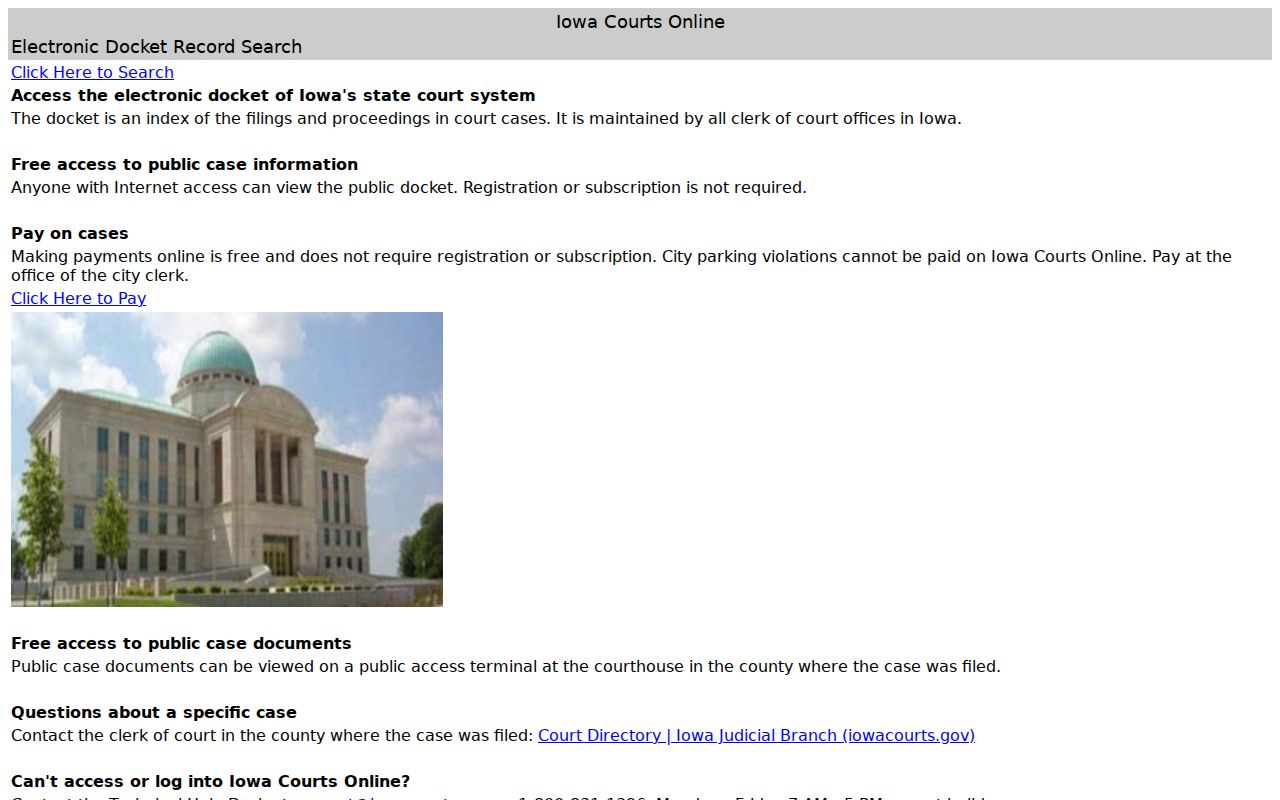
The statewide screen is only the entry point. The case page and clerk-held documents supply the event detail that a list of hits cannot.
Missing Emmet County Court Documents
A visible Emmet County case does not guarantee that each document can be opened from home. Some links and images are restricted to a courthouse public terminal or paid subscriber access. Confidential filings remain unavailable even there. When a docket entry appears without a usable image, note the Case ID, event date, and document title before contacting the clerk. Those details are far more precise than asking staff to find every record tied to a name.
Older Emmet County criminal cases may also require direct clerk help if indexing is incomplete or a spelling changed. Ask whether the file is available for inspection, whether a copy can be supplied, and whether certification is needed. The research did not locate a current Emmet County copy or certification fee, so request a live estimate. Do not borrow a fee from another Iowa county.
Clerk of District Court
Emmet County Courthouse
609 1st Avenue N.
Estherville, IA 51334
Monday-Friday
8:00 a.m.-4:30 p.m.
Note: Bring the Case ID and event date to help the clerk locate an Emmet County court record without relying on a broad name search.
What a Criminal Case File Contains
An Emmet County case file is built around filed allegations and court action. The header identifies the case, county, filing date, case type, and status. Count entries connect a charge description with an Iowa Code section, offense class, offense date, and result. Events then show how the case moved, including a complaint or citation, initial appearance, trial information, arraignment, motions, hearings, plea, judgment, sentence, and any appeal-related activity.
| Case ID and Court | The official identifier, Emmet County venue, case type, filing date, and current status. |
|---|---|
| Filed Charges | Each count, statute, offense class, alleged date, and count-level disposition. |
| Participants | The State of Iowa, defendant display name, and public attorney roles. |
| Docket Events | A dated sequence of filings, appearances, orders, motions, pleas, and hearings. |
| Disposition | The outcome for each count, such as conviction, dismissal, or acquittal. |
| Judgment and Sentence | The final court order, sentence, costs, fine, restitution category, and public payment activity. |
| Documents | Public images when permitted; some links require terminal or subscriber access. |
A financial line is not a full sentence history. The Judicial Branch court debt resource explains payment channels, while the docket and judgment show why a balance exists.
The official court debt source shown here helps separate payment activity from the full Emmet County criminal case record.

A paid balance does not by itself reveal whether a count was dismissed, amended, or resolved by judgment. Read the disposition and sentence entries.
Reading Emmet County Case Outcomes
Court terms are compact because the docket must record many events. A disposition is the result assigned to a charge. A dismissal ends that charge without a conviction on it. An acquittal is a not-guilty result after trial. A deferred judgment is an Iowa process that withholds judgment while the person completes ordered conditions. Successful completion can lead to discharge and court-record expungement under the governing law, but it should not be confused with a dismissal at the outset.
- Arraignment
- The hearing where the filed charges and plea are addressed.
- Trial information
- The prosecutor-filed charging document used for an indictable offense.
- Docket
- The dated list of events and filings in the Emmet County case.
- Disposition
- The recorded outcome for a charge or the case.
- Restitution
- Court-ordered payment for qualifying victim loss.
Always read outcomes count by count. One case may contain an amended charge, one dismissed count, and another count resolved by plea. A single status label cannot safely stand in for that detail.
Criminal Case Stages in Emmet County
The court case begins when a complaint, citation, trial information, or indictment is filed. An initial appearance addresses identity, the allegation, counsel, and release matters. At arraignment, the plea is recorded. Pretrial work can include discovery, motions, conferences, and hearings. The case then reaches a plea, trial, dismissal, or another lawful result. A conviction leads to judgment and sentencing, while later events may involve payment, appeal, probation action, or expungement proceedings.
Case flow: Charges Filed › Arraignment › Pretrial › Plea or Trial › Disposition › Sentencing
This Emmet County sequence also explains why an arrest-stage allegation may not match the final Emmet County criminal court file. The arresting officer records the suspected offense. The county attorney decides what to file, and the court records what happens to each filed count. For deeper arrest-stage context, the county's arrest search information follows the separate agency and jail records.
Emmet County and Federal Cases
Conduct in Emmet County can produce a federal case instead of, or alongside, an Iowa case. Federal criminal filings belong to the U.S. District Court for the Northern District of Iowa. They do not appear in Iowa Courts Online merely because the event occurred in the county. The official PACER system supplies federal dockets and filed documents after registration, subject to federal judiciary fee rules.
The official PACER source shown in this capture is the correct federal search layer when an Emmet County name or event does not belong to the state docket.
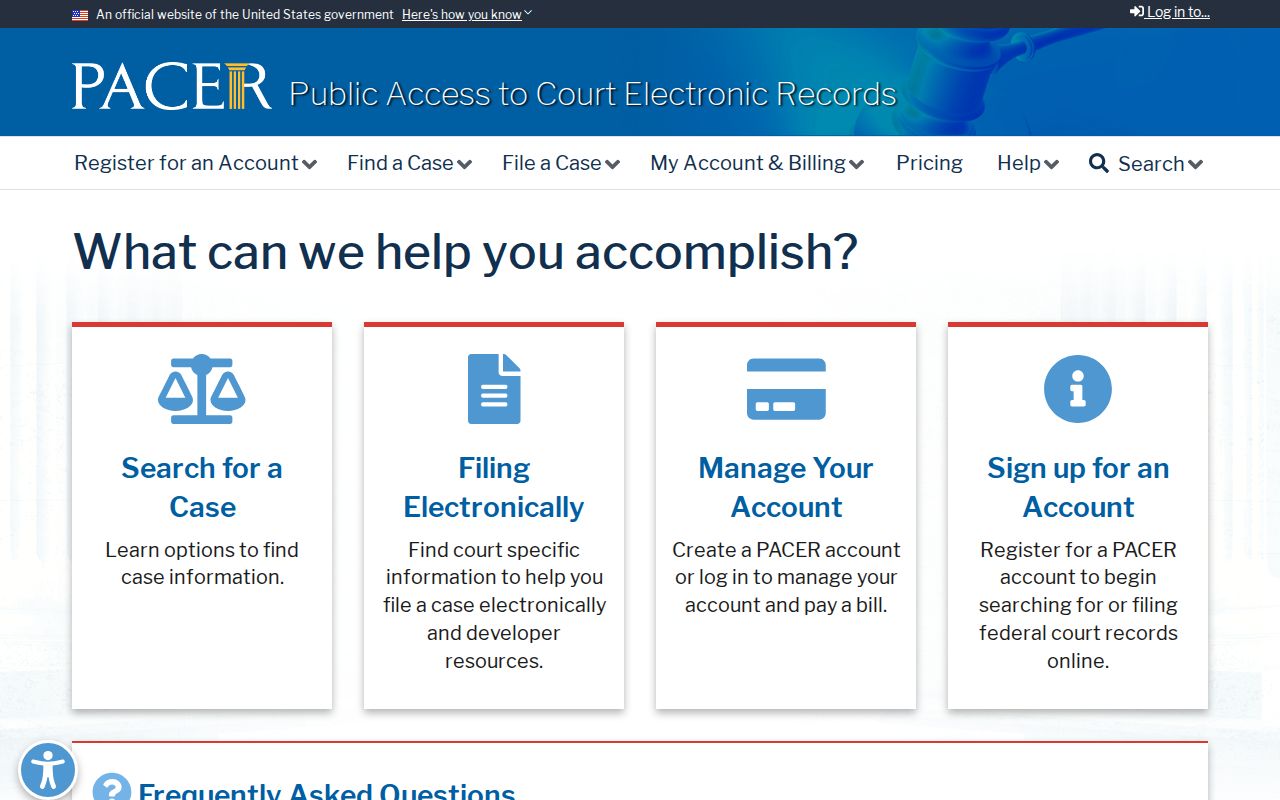
PACER does not replace the local clerk. It is a distinct court system with its own case numbers, documents, and access rules.
The Northern District of Iowa website shown in the source image provides current federal court notices and office information.
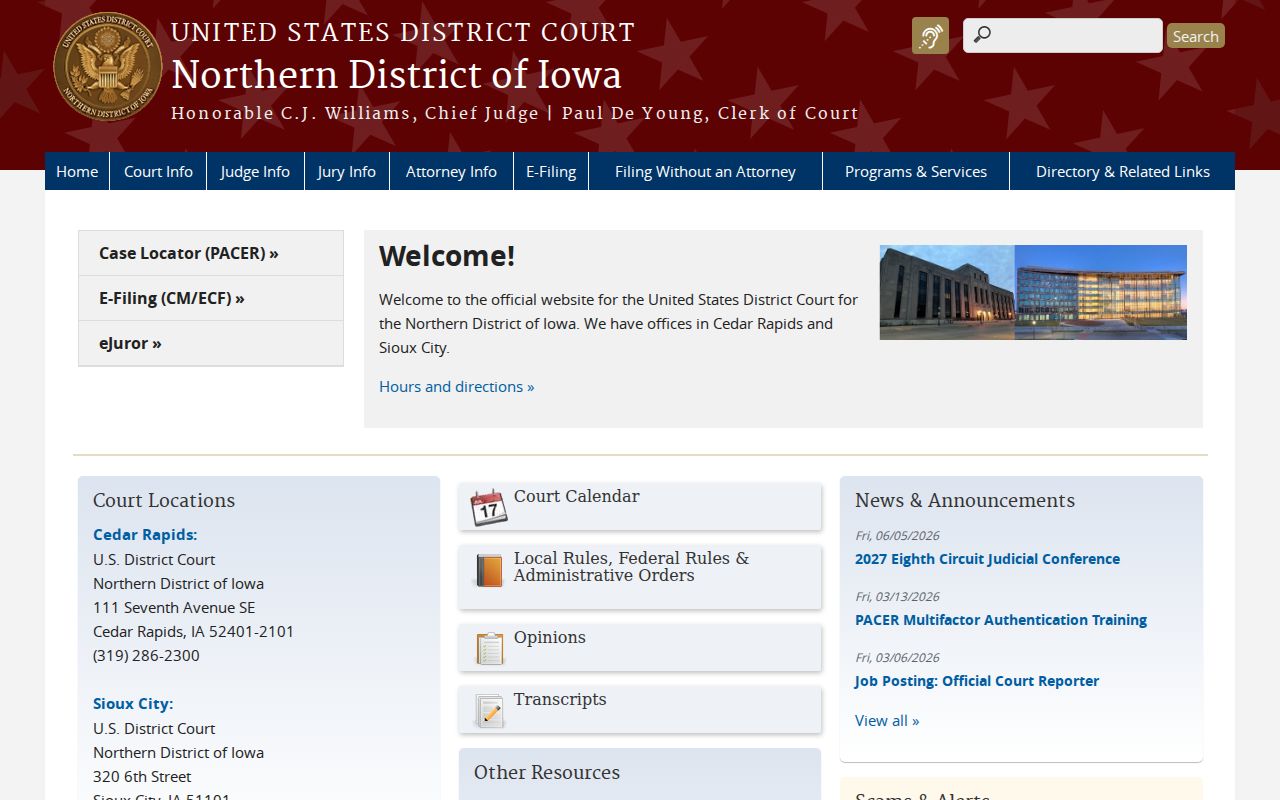
Use the district site to confirm federal procedures before travel, while using PACER for the docket itself.
Access Rules for Case Records
Iowa court records are generally open, but public access has defined limits. Iowa Court Rules chapter 16 governs electronic access and protected court data. Juvenile matters, sealed or expunged material, protected identifiers, and confidential documents do not appear in the public view. Victim, medical, and other protected information may be redacted. A blank search therefore cannot prove that no event ever occurred.
Iowa Code chapter 22 governs public records held by agencies, while court electronic access follows Judicial Branch rules. Those channels should not be merged. Ask the clerk about a filed document. Ask the creating law enforcement agency about its report. Use the Iowa Department of Public Safety, Division of Criminal Investigation for a statewide repository record.
Case files, arrest reports, and DCI histories are separate records. A restriction or blank result in one system does not erase the others.
For qualifying acquittals, dismissals, or completed deferred judgments, Iowa provides limited forms of expungement under chapter 901C and chapter 907. Relief is case-specific. Check each count and use the current Judicial Branch forms rather than assuming that a closed case is hidden automatically.
When Emmet County Cases Stay Hidden
A missing result can stem from a spelling mismatch, the wrong county, a federal filing, a confidential case, an expungement order, or a document that requires courthouse access. Start with fewer search fields. Confirm Emmet County. Then use the clerk's terminal or desk with the strongest identifier available. If the question is about a statewide fingerprint-supported history instead of a court case, request that separate product from DCI.
Do not use an Emmet County court debt line as a substitute, and do not infer identity from a common name. Match the case number, filed date, charge facts, and public participant data. This modest verification step prevents a different person's Emmet County court record from being treated as the one sought.
Note: A name-only Iowa Courts Online hit should be checked against case facts or the clerk before any conclusion is drawn.